
Antimicrobial Efficacy of Sevoflurane in Infected Wounds
DOI:
https://doi.org/10.71336/ijvar.702Keywords:
Antimicrobial activity, Skin lesions, Methicillin-resistant, Staphylococcus aureus, Topical sevofluraneAbstract
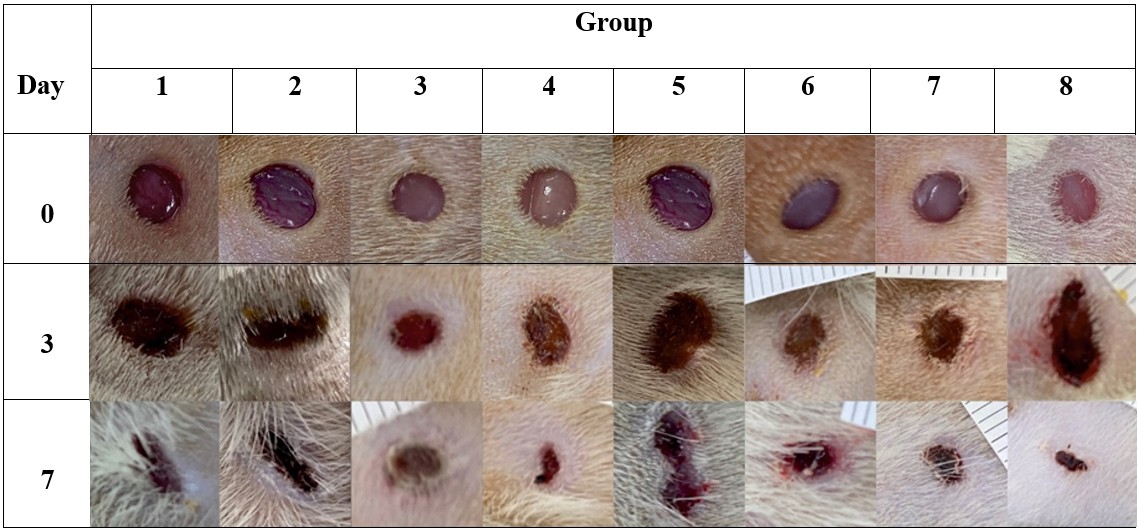
The aim of this study was to investigate the antimicrobial efficacy of sevoflurane in wounds infected with Staphylococcus aureus, a species known for rapid antibiotic resistance. The study material was formed of 80 healthy, male Sprague-Dawley rats. A wound was created in each animal, and then infected with methicillin-sensitive Staphyloccocus aureus and with methicillin-resistant Staphyloccocus aureus. Isotonic sodium chloride, hypochlorous acid and liquid sevoflurane were applied to the wounds. Our results show that sevoflurane exhibited greater antimicrobial efficacy than both hypochlorous acid and isotonic sodium chloride in wounds infected with Staphyloccocus aureus. Therefore, topical use of sevoflurane could be considered a viable alternative, particularly for methicillin-resistant Staphyloccocus aureus infections. The wound healing with topical liquid sevoflurane was also seen to be more rapid than those with hypochlorous acid and isotonic sodium chloride.
References
Cha MS, Lee HJ, Bae JH, Yang WS, Baik SW. 2009. Effects of sevoflurane on wound healing process. Korean Journal of Anesthesiology, 57(1), 78-83. DOI: 10.4097/kjae.2009.57.1.78. DOI: https://doi.org/10.4097/kjae.2009.57.1.78
Cheng AG, Dedent AC, Schneewind O, Missiakas D. 2011. A play in four acts: Staphylococcus aureus abscess formation. Trends in Microbiology, 19(5), 225-232. DOI: 10.1016/j.tim.2011.01.007 DOI: https://doi.org/10.1016/j.tim.2011.01.007
Çelik E, Arslankoz S, Koyuncu P, Öğüş E, Polat R, Dönmez A. 2025. From anesthesia to healing: the potential of topical sevoflurane in enhancing wound repair. Eurasian Journal of Anesthesiology an Intensive Care, 2(1):1-6. DOI: 10.51271/EAJAIC-0021. DOI: https://doi.org/10.51271/EAJAIC-0021
Gencay I. Topical Sevoflurane: An Alternative Treatment for Pressure Ulcers. 2019. Journal of the College of Physicians and Surgeons Pakistan, 29(12), 92-94. DOI: 10.29271/jcpsp.2019.12.S92. DOI: https://doi.org/10.29271/jcpsp.2019.12.S92
Gottlieb M, Schmitz G, Grock A, Mason J. 2018. What to do after you cut: recommendations for abcess management in the emergency setting. Annals Emergency Medicine, 71, 31-33. DOI: 10.1016/j.annemergmed.2017.11.006. DOI: https://doi.org/10.1016/j.annemergmed.2017.11.006
Imbernon-Moya I, Ortiz-De Frutos FJ, Sanjuan-Alvarez M, Portero-Sanchez I, Merinero-Palomares R, Alcazar V. 2017. Topical sevoflurane for chronic venous ulcers infected by multi-drug-resistent organisms. International Wound Journal, 14(6), 1388-1390. DOI: 10.1111/iwj.12794. DOI: https://doi.org/10.1111/iwj.12794
Kobayashi SD. 2015. Pathogenesis of Staphylococcus aureus abcess. American Journal of Clinical Pathology, 185(6), 1518-1527. DOI: 10.1016/j.ajpath.2014.11.030. DOI: https://doi.org/10.1016/j.ajpath.2014.11.030
Kuwabara M, Ishibara M, Fukuda K, Nakamura S, Murakami K, Sato Y, Yokoe H, Kiyosawa T. 2018. Disinfection of Pseudomonas aeruginosa-infected wounds in diabetic db/db mice by weakly acidic hypochlorous acid. Wound Medicine, 23, 1-5. DOI: 10.1016/j.wndm.2018.09.001. DOI: https://doi.org/10.1016/j.wndm.2018.09.001
Lee HJ, Kwon JY, Shin SW, Baek SH, Choi KU, Jeon YH, Kim WS, Bae JH, Choi HJ, Kim HK, Baik SW. 2010. Effects of sevoflurane on collagen production and growth factor expression in rats with an excision wound. Acta Anaesthesiologica Scandinavica, 54, 885-893. DOI: 10.1111/j.1399-6576.2009.02190.x. DOI: https://doi.org/10.1111/j.1399-6576.2009.02190.x
Martinez-Monsalve A, Selva-Sevilla C, Geronimo-Pardo M. 2018. Analgesic effectiveness of topical sevoflurane to perform sharp debridement of painful wounds. Journal of Vascular Surgery, 69(5), 1532-1537. DOI: 10.1016/j.jvs.2018.08.175. DOI: https://doi.org/10.1016/j.jvs.2018.08.175
Mölne L, Tarkowski A. 2000. An experimental model of cutaneous infection induced by superantigen-producing Staphylococcus aureus. Journal of Investigative Dermatology, 114(6), 1120-1125. DOI: 10.1046/j.1523-1747.2000.00973.x. DOI: https://doi.org/10.1046/j.1523-1747.2000.00973.x
Rosser EJ. 2006. Pyoderma, in: Birchard SJ, Sherding RG. (Eds.), Saunders Manuel of Small Animal Practice. 3rd ed. Saunders Elsevier, Missouri, pp. 420-428. DOI: https://doi.org/10.1016/B0-72-160422-6/50040-1
Rueda-Martinez JL, Geronimo-Pardo M, Martinez-Monsalve A, Martinez-Serrano M. 2014. Topical sevoflurane and healing of post-operative surgical site superinfected by multi-drug-resistent Pseudomonas aeruginosa and susceptible Staphylococcus aureus in a immunocomprimised patient. Surgical Infections, 15(6), 843-846. DOI: 10.1089/sur.2013.079. DOI: https://doi.org/10.1089/sur.2013.079
Sakarya S, Gunay N, Karakulak M, Ozturk B, Ertugrul B. 2014. Hypochlorous acid: an ideal wound care agent with powerful microbicidal, antibiofilm, and wound healing potency. Wounds, 26(12), 342-350.
Turhanoglu NM, Koyuncu E, Bayindir-Bilman F. 2018. Microorganisms and antibiotic resistances isolated from wound cultures. Türk Hijyen ve Deneysel Biyoloji Dergisi, 75(2), 183-194. DOI: 10.5505/TurkHijyen.2018.56338. DOI: https://doi.org/10.5505/TurkHijyen.2018.56338
Winn WJ, Allen S, Janda W, Koneman E, Procop G, Schreckenberger P, Woods G. 2006. Koneman’s Color Atlas and Textbook of Diagnostic Microbiology, sixth ed. Lippincott Williams and Wilkins, Philadelphia.
Downloads
Published
How to Cite
Issue
Section
License
Copyright (c) 2026 International Journal of Veterinary and Animal Research (IJVAR)

This work is licensed under a Creative Commons Attribution-NonCommercial-NoDerivatives 4.0 International License.